

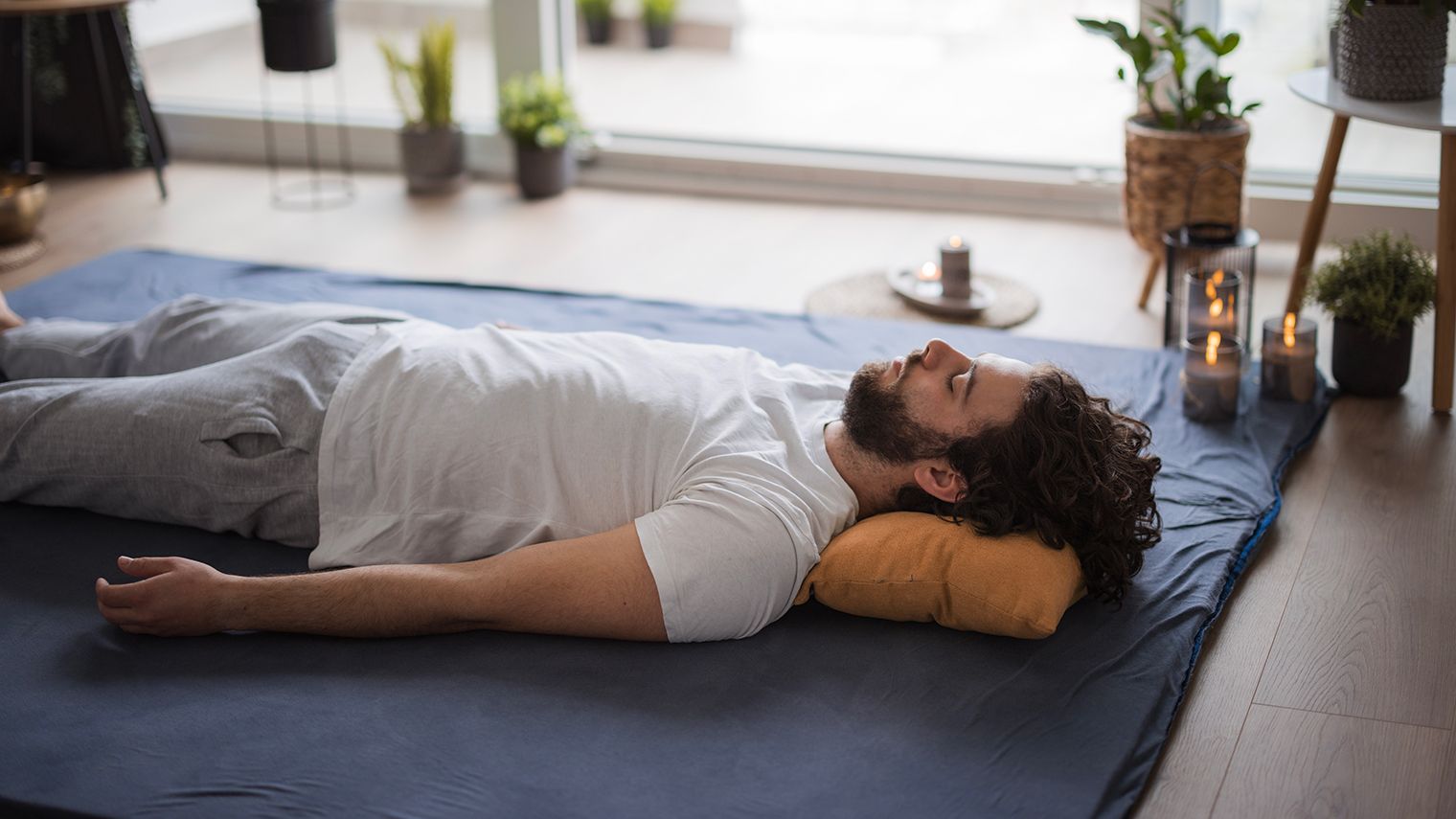
Photography by Dobrila Vignjevic/Getty Images
by Monica Lynne
•••••
Medically Reviewed by:
Nancy Hammond, M.D.
•••••
4
Less focused than meditation, more flexible than Yoga Nidra, non-sleep deep rest (NSDR) can offer people with chronic fatigue a way to recharge.
When exhaustion feels like a constant companion and your mind won’t stop racing, finding true rest can feel impossible. That’s where non-sleep deep rest (NSDR) comes in. This wellness practice is gaining attention for its ability to recharge the body and calm the mind without requiring actual sleep.
For people who are managing a chronic condition such as multiple sclerosis (MS), which can cause significant fatigue and brain fog, NSDR offers a promising way to reclaim mental clarity and replenish energy.
While research specifically on NSDR is still emerging, its potential benefits make it a tool worth exploring.

ADVERTISEMENT
Give therapy a try, from the comfort of your home.
With BetterHelp, get matched with a therapist within 48 hours. Once matched, you can start messaging them right away.Get started with 20% off

What is non-sleep deep rest?
NSDR is a state of profound relaxation achieved without actually falling asleep. It involves intentionally slowing down your mind and body through techniques designed to engage your parasympathetic nervous system — the part of your nervous system that’s responsible for rest and recovery.
Neuroscientist Dr. Andrew Huberman popularized the term, describing NSDR as a practice that combines deep relaxation with focused awareness to promote both mental and physical recovery.
NSDR typically follows a structured, guided process that gently leads your mind into a deeply restorative state. Techniques might include body scans, breathing exercises, and visualizations that help release tension and promote calm.
Advertisement
Ad revenue keeps our community free for you
NSDR vs. Yoga Nidra and meditation
NSDR has some similarities to Yoga Nidra, an ancient Indian practice that’s sometimes called “yogic sleep,” but they aren’t identical. Yoga Nidra typically follows a specific sequence rooted in yoga philosophy, while NSDR is less formal and more focused on achieving relaxation without the philosophical framework.
Meditation, on the other hand, often requires active concentration — whether on your breath, a mantra, or an intention — while NSDR invites a more passive surrender into relaxation.
Basically, NSDR strikes a balance: It requires less effort than meditation and offers more flexibility than Yoga Nidra. This is why it’s a more approachable practice for stress relief and energy restoration for some people.
NSDR for energy management

 English
  French
Hi, this is a comment.
To get started with moderating, editing, and deleting comments, please visit the Comments screen in the dashboard.
Commenter avatars come from Gravatar.