
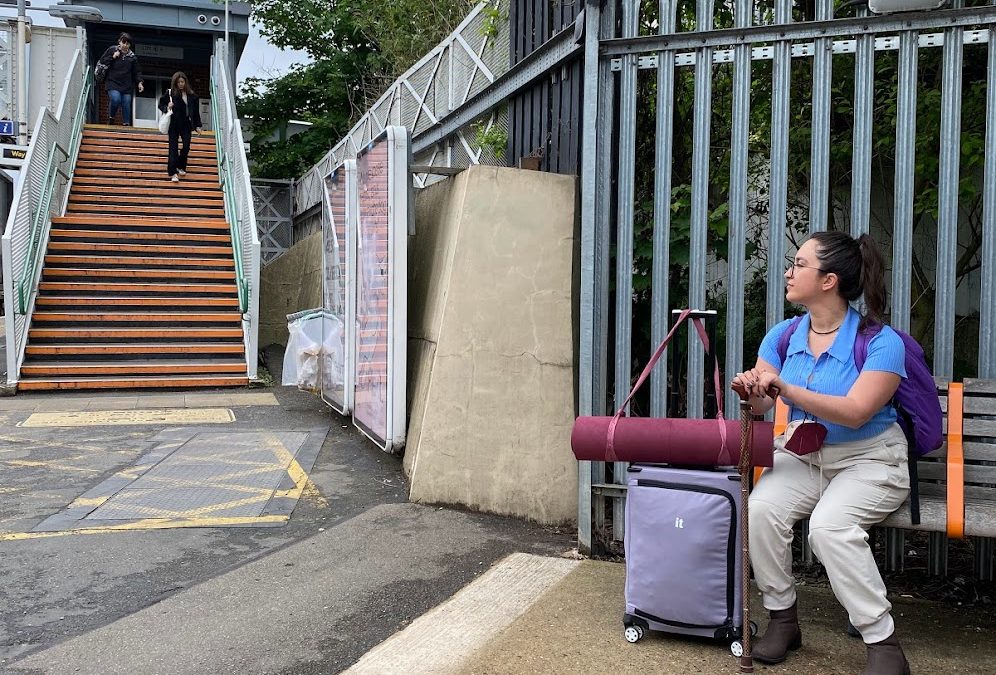
Long travel days can be draining for anyone. When you’re living with a chronic illness like multiple sclerosis, they can feel especially demanding. Hours of sitting, standing in lines, carrying bags, and navigating unfamiliar environments can quietly take a toll on your body before you even realize it. Here’s the key: tiny movement breaks.
This is the part I wish someone had told me sooner: staying comfortable during travel gets a lot easier when you stop waiting for discomfort to hit. What helps is weaving in small, intentional moments of movement that help your body reset along the way.
And yes, you’ll absolutely see someone roll out a yoga mat and do a whole routine in a quiet corner of the airport. Love that for them. You could totally do that and it works. But if you want something more discreet, these tiny movement breaks are simple, subtle, and surprisingly effective, even in the middle of a crowded terminal.
If you’re wondering what counts as a tiny movement break, it can be as small as 20–60 seconds of gentle movement. No outfit. No equipment. No “look at me” energy. Just enough to keep stiffness from stacking up.
Take what works, skip what doesn’t, and keep everything pain-free.
Practical takeaways (so you can try this today)
Save this for your next travel day.
- While waiting: weight shifts, ankle circles, calf stretch
- While seated: shoulder rolls, gentle torso twists, chin tuck, foot pumps
- When standing: posture reset + slow breathing
- In restrooms or quiet corners: hamstring stretch, hip rolls, shake-outs (and a quick quad stretch)
- Most important: start early, before your body hits its limit
A simple pacing idea that helps: pick two moves from the list and do them once an hour, or every time you hit a transition, like boarding, baggage claim, or the next gate.
Gentle Movement While Waiting
Airports, train stations, and terminals involve a lot of hurry-up-and-wait. And wait and wait. Instead of locking your body into one position, use those moments to move just enough to stay loose.
This is usually when you do the movement that looks like nothing.
Gently shift your weight from side to side and front to back, massaging the pads of your feet with the floor. Do a few slow ankle circles, or lightly stretch your calves while standing near a wall or counter. If you’re seated, extend one leg at a time and flex your foot to get circulation going.
If you’re thinking, “Is this enough to matter?” yes. These tiny things help prevent stiffness from building up before it becomes uncomfortable.
Seated Resets During Long Rides
On planes, trains, or buses, focus on small movements you can do without leaving your seat. Seated stretches on a plane can be simple and still effective.
This is where the “tiny” part matters, because the point is focused release of stiff muscles. You’re aiming for a targeted “ahhh” feeling, not a workout.
Try this mini sequence:
- Roll your shoulders forward and back
- Gently twist your torso side to side
- Tuck your chin down for a calm stretch in the back of your neck
- Press your feet into the floor for a few seconds, then release
- Do foot pumps, toes up then heels up, like you’re waking up your legs
Even a minute or two of intentional movement can make a difference when you’re sitting for hours. If standing isn’t accessible today, seated resets still count. They count a lot.
Standing Breaks That Don’t Overdo It
When you have the chance to stand, don’t treat it as a cue to do more, you overachiever. Treat it more like a reset. Standing isn’t a do-more moment. It’s a come-back-to-your-body moment.
Stand tall, take a few slow breaths, find your plumb line (the alignment of your spine, up your neck), find tightness in your body and focus on melting that tension away. Let your body settle before moving on. Sometimes that’s all it takes to reduce tension and avoid that weighted feeling that can come from doing too much at once.
If you’re using a cane that day, lean into it and let it do its job. You can even use it as a counterweight to deepen a gentle stretch, as long as it feels steady and supportive.
Micro Stretches in Restrooms or Quiet Corners
Restrooms, quiet hallways, or empty gates are often the best places for slightly bigger resets.
Stretch your hamstrings, gently roll your hips, shake out your hands and arms, and add a quick quad stretch if it feels good. These moments don’t need to be long. Face a quiet corner of the space, focus on your breath, and if you want privacy, put on visible headphones as a simple “I’m having a private moment,” nonverbal signal. This is for comfort, not performance.
Stepping away for a brief reset can be far more helpful than trying to power through until you’re exhausted.
Listening for Early Signals
One of the biggest shifts you can make is paying attention sooner.
If your legs start to feel heavy, if your balance feels off, or if MS fatigue creeps in, don’t wait for it to escalate. That you noticed is usually your cue to pause, sit, or move gently before your body forces the issue.
If you’re wondering, how the heck am I supposed to remember that in the middle of a transit hustle? Or how do you pace movement with MS while traveling? This is the simplest answer: reset early, keep it small, and treat transitions as your reminders. Boarding, bathroom break, gate change, baggage claim. Tiny cue, tiny reset.
These movement breaks work best when they’re preventative, not reactive.
Quick safety note: stop if you feel sharp pain, dizziness, or a sudden symptom flare. Keep it gentle.
The Short & Sweet
Long travel days don’t require endurance. They require awareness.
These small movement breaks can help you stay more comfortable, more present, and more connected to your body while you’re on the move. They don’t eliminate fatigue, but they soften its impact.
Travel doesn’t have to be about pushing through. Sometimes it’s about meeting your body where it is and giving it just enough care to keep going.

 English
  French
Hi, this is a comment. To get started with moderating, editing, and deleting comments, please visit the Comments screen in…