
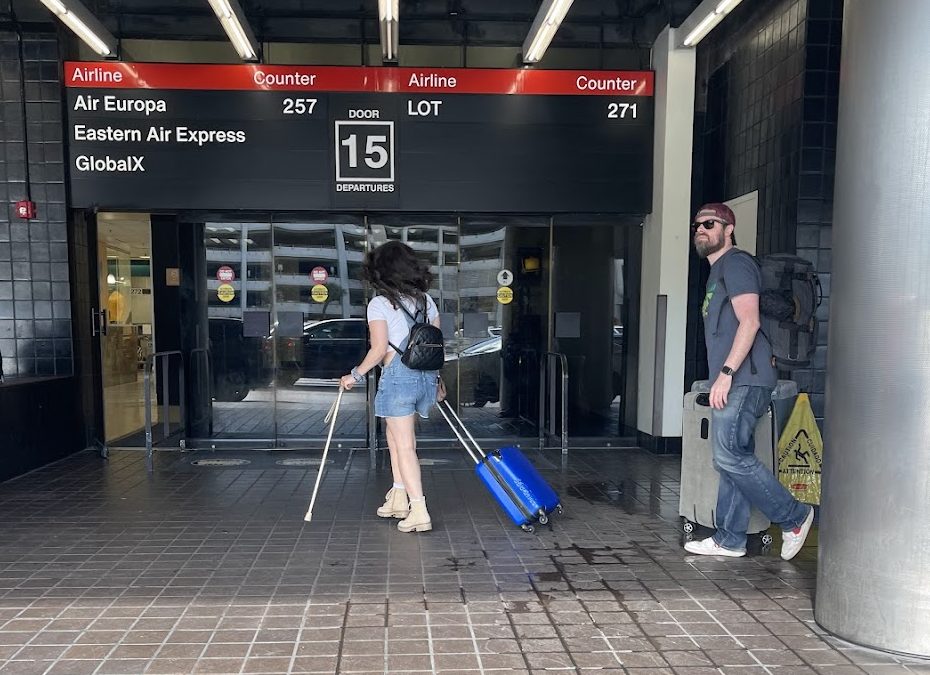
Simple, subtle movement strategies for long travel days with chronic illness
Long travel days have a way of collecting on your body. Each hour of sitting, each security line shuffle, each overhead bin reach… they stack. And when you have MS, that stacking happens faster and with way less warning than you’d like.
The part nobody tells you, though: you don’t need to power through. You need to pace through.
Small, intentional movement breaks woven into your travel day are like tiny, lil exhales. That’s the shift – the lil. Not a yoga mat in Terminal C (although honestly, mad respect to that person – they’re just built differently). Just 20 to 60 seconds of gentle, purposeful movement that reminds your body where the baseline is… sweet homeostasis.
Keep what works for you, leave what doesn’t. Keep it discomfort-free and keep it yours.
The Part I Wish Someone Had Told Me Sooner
By the time your legs feel heavy or your balance starts getting wobbly, you’ve already waited too long.
Start before you even need to. The goal is prevention, not damage control.
Think of it like watering a plant – you don’t wait until it’s already wilting. You show up before the crisis, consistently.
While You’re Waiting (And You Will Be Waiting)
Airports are a masterclass in hurry-up-and-wait. There’s security and boarding, delays and layovers, and so much standing around dressed up as urgency. Use transitions as your timer: boarding, bathroom break, gate change, baggage claim. Every time you move from one thing to the next, that’s your cue for a tiny movement reset.
Shift your weight side to side, gently, like you’re slow-dancing with the floor. Let your feet feel the ground beneath them: the pads, the arches, the heels. Do a few slow ankle circles. Stretch your calves against a wall or counter if one’s nearby. If you’re seated, extend one leg, flex your foot – this supports your circulation.
These moves look like nothing, and that’s the point. It’s discreet, and nobody’s watching anyway. And even if they were, you’re taking care of yourself in a crowded terminal. That’s actually kind of radical.
Resets on the Plane, Train, or Bus
This is where tiny really matters, because you’re not going anywhere and neither is the person in the middle seat.
You’re not going for a workout. You’re going for that targeted ahhh: that small release of a muscle that’s been holding on too long.
Even two minutes of movement breaks the spell of prolonged stillness. Try this when you feel yourself stiffening:
- Roll your head and shoulders forward, then back, slowly, like you’re drawing lazy circles in the air
- Twist your torso gently side to side, just enough to feel a soft release
- Tuck your chin down and feel the back of your neck lengthen
- Press your feet flat into the floor for a few seconds, then let go
- Foot pumps: toes up, heels up
When You Get to Stand
Don’t treat standing as a do-more moment. Treat it as a come-back-to-yourself moment.
Stand tall, breathe deep and slow. Find your plumb line: that invisible thread running up your spine, through the crown of your head. Notice where you’re holding tension and imagine it melting, just a little, just enough. I tend to hold tension in my jaw and shoulders, so when I release my tense hold, they drop and relax – again, like an exhale.
This isn’t about doing more or being extra. It’s about arriving – at your gate, at your destination, in your body – instead of just passing through.
Restrooms and Quiet Corners Are Underrated
Find a quiet hallway or an empty gate. I’ve even found a single-stall restroom and managed with a little space. That’s all tiny movement needs anyway.
Stretch your hamstrings. Roll your hips. Shake out your hands and arms like you’re flicking water off your fingertips. Add a quad stretch if it feels good. If you’re in a public space, you can even put on visible headphones to communicate an I’m-having-a-private-moment, non-verbal signal.
This is maintenance. And maintenance, done consistently is what keeps you moving through a long travel day without suffering through it or after it.
Listening for the Early Signals
Your body whispers before it yells: heavy legs, a slight teeter in your balance, that creeping MS fatigue that feels like someone slowly dimming the lights. These are merely whispers. Don’t wait for the yelling to start.
When you notice something shifting, that noticing is the cue. Sit down or move gently. Reset before your body forces the issue.
The simplest pacing strategy I know: pick two moves from the list above and do them once an hour, or at every transition. Low bar, high impact.
One quick note: if you feel sharp pain, sudden dizziness, or a symptom flare, that’e the cue to just stop. Always keep it gentle. Your body is the boss here, not the itinerary.
Long travel days don’t require endurance. They require awareness.
The Short & Sweet
These tiny movement breaks won’t eliminate fatigue (nothing does, and anyone who tells you otherwise is probably selling something), but they do soften its edges. Short bits of shifting in your skin keep you more present, more comfortable. Finding moments of motion keeps you more connected to your body while you’re moving in transit.
Travel doesn’t have to be about pushing through it. Meet your body where it is, give it just enough care to keep going, and trust that showing up gently and intentionally is more than enough.
Have a movement break that works for you on travel days? Drop it in the comments: I’d love to add it to my routine too!
status quo → go 🧡
This post may contain affiliate links. I may earn a small commission at no extra cost to you, but I only recommend products I actually love, promise.