
What nobody tells you about flying, fatigue, medication, and pacing
If you have MS and you are nervous about flying, here is the most important thing to know first: the airport support you need is already there, it is free, and most people never use it because nobody told them it existed. You can request wheelchair assistance from your airline at no cost, you can call TSA Cares to smooth out security, and you can keep your medication with you the entire flight. None of this requires you to look a certain way or prove how sick you are. It requires a few phone calls and knowing what to ask for. Here is exactly how I do it.
Flying with MS starts before you ever reach the airport
For years I treated the airport as something to survive. I’d walk the whole terminal when I had already used up the energy I had for the day, stand in every line, and arrive at my gate with nothing left for the actual flight. By the time I landed, my first day somewhere new was a total wash.
The fix was not pushing harder. It was learning that an entire support system exists specifically so I do not have to push at all.
Most of it has to be requested in advance. That is the part nobody tells you. The help is free and it is your right, but it does not come find you. You have to ask, and you have to ask early.
One quick thing worth knowing, because most people get it wrong: flying is not actually covered by the ADA. Air travel falls under a different law, the Air Carrier Access Act, which bars airlines from discriminating against passengers with disabilities and requires them to provide this help for free. The ADA still covers the airport itself, the terminal, the transit, the bathrooms. But the moment you are dealing with the airline, the ACAA is your law. Knowing which one applies makes you a lot harder to brush off.
How to request wheelchair assistance
Here is the thing I wish someone had said to me sooner: wheelchair assistance at the airport is not only for people who cannot walk at all. The service exists to get you across enormous distances without draining you. That is what it is for. Whether you can walk some, most, or none of it is not the point.
Airports are enormous. The walk from security to a far gate can be the equivalent of a long hike, and at a big international hub it can mean terminal changes, trains, and standing in line after line. If covering that distance on foot would burn through the energy you need for the rest of your travel day, you qualify. Foot drop, fatigue, balance, heat sensitivity, all of it counts. You do not have to justify the gap between how you look and what you need.
You request it from your airline, not the airport and not TSA. The easiest way is to add it when you book, usually under a heading like “special assistance” or “accessibility needs.” If you already booked, log back into your reservation or call the airline. Aim for at least 48 hours ahead so they can guarantee staff.
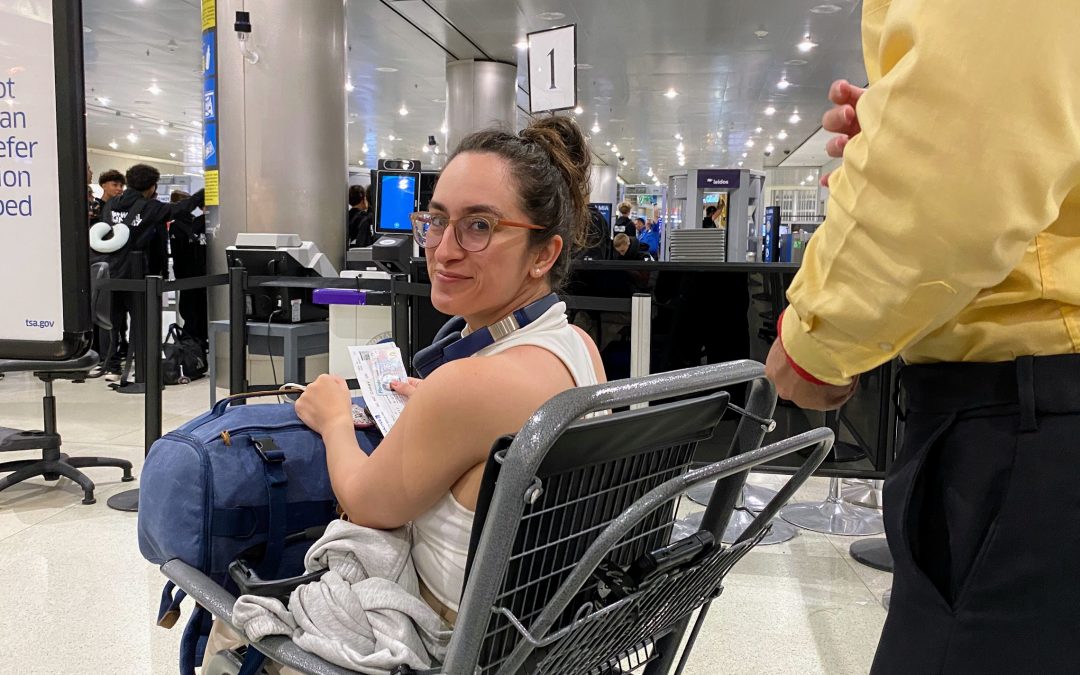
What you get: someone meets you, often at the curb or check-in, and takes you through security, to your gate, and right onto the plane. You typically board early. On the other end, someone meets you at the aircraft door and takes you to baggage claim or your connection. It is free, every airline flying to or from the US is legally required to provide it under the Air Carrier Access Act, and they cannot charge you for it regardless of your ticket class.
One detail that genuinely helped me relax: if you are not independently mobile, the airline is not allowed to leave you unattended for more than 30 minutes. You are not going to be parked and forgotten.
What TSA Cares actually does, and the number to call
TSA Cares is the second free thing nobody mentions. It is a helpline that arranges extra help getting through security screening, and it is separate from your airline’s wheelchair service. The two work together.
You call TSA Cares at 855-787-2227 at least 72 hours before your flight. Tell them when and where you are flying and what would make screening easier for you. They coordinate with security at your specific airport so you are not explaining your whole situation cold at the checkpoint with a line building behind you.
A Passenger Support Specialist can meet you and walk you through the process. If you cannot stand or walk through the scanner the way it normally requires, you can stay seated and be screened another way. You can tell the officer about a medical device, a port, or anything else before screening starts. You are allowed to ask for private screening. You are allowed to keep your traveling companion with you.
Knowing this in advance changed security from my most dreaded part of flying into a non-event.
Your medication rules
This one is simple and non-negotiable: your medication goes in your carry-on, never your checked bag. Checked bags get lost, delayed, and rerouted, and your treatment is not something you can afford to chase across an airport.
Medically necessary liquids are allowed through security in quantities over the usual 3.4 ounce limit. You just tell the officer you have medically necessary liquids before screening begins. They may test the containers, but they will not make you open or pour out anything, and you can ask that liquid medication not be X-rayed.
For those of us on infusion treatments, the meds themselves usually are not something you fly with day to day, but anything you do carry, oral medications, injectables, supplies, belongs in your carry-on in its original labeled packaging. I keep mine in a clear pouch right at the top of my bag so I am not digging.
A doctor’s letter is worth the five minutes it takes to ask for one. A short note on letterhead stating your diagnosis, your medications, and any devices or supplies you travel with can quietly resolve almost any question at security or a border. I have rarely needed to show mine. I am always glad it is there.
Seat, layers, and timing: the in-flight setup that prevents flares
Once you are on the plane, a few choices make the difference between landing depleted and landing okay.
Seat: an aisle seat near the front means less walking, easier bathroom access, and getting off faster. If you use wheelchair assistance you often board first and deplane last, so a front seat shortens the wait.
Layers: cabin temperature swings, and for those of us whose symptoms spike with heat, that matters more than it sounds. Heat sensitivity in MS is a real neurological response, not a preference. When your core temperature rises, nerve signals along already-damaged pathways slow down, and symptoms you thought were handled come roaring back. Dress in layers you can strip down to, and if you run hot, a small cooling towel in your bag is worth its weight.
Timing: book the flight that protects your energy, not the one that saves forty dollars. A mid-morning departure that lets you sleep and arrive calm can be worth more than a brutal red-eye. I plan the whole day around landing with something left in the tank.
Hydrate more than feels necessary. Cabin air is dry, dehydration worsens fatigue, and the bathroom trips are a feature, not a bug, because they get you moving.
What to do if a flare hits mid-flight
Sometimes you plan well and a flare comes anyway. That is not a failure of planning. That is MS. A flare at 35,000 feet feels scary mostly because you feel trapped. Here is what actually helps.
Cool down first. Strip a layer, put the cooling towel on the back of your neck, turn the overhead air vent directly on yourself. Lowering your body temperature is the fastest lever you have.
Then downshift everything. This is where a recovery practice matters, and the one I lean on is NSDR, non-sleep deep rest, a way of dropping your nervous system into a deep state of calm while fully awake. A short session with headphones in a reclined seat can pull you back from the edge of a flare without needing anything but your phone.
Tell a flight attendant. They are trained, they can bring water and ice, and they would much rather know early than late. You are not being dramatic. You are managing a medical condition at altitude.
And let go of the rest of the day’s plan. If you land and need to do nothing, that is not the trip going wrong. That is you having built rest into the bones of the trip on purpose.
How this fits the bigger picture of traveling with MS
Flying is just one piece. The reason I can do this at all, fly to a new country and stay long enough to actually live there, is that I have built a whole approach around the body I have, and the flight is one carefully planned part of it. If you want the full picture, start with my guide on traveling with MS].
Part of how I keep long trips affordable and gentle is house sitting, which gives me a real home base instead of a hotel and cuts my costs to almost nothing. When the flight is handled and a calm place to land is waiting on the other end, the whole thing stops feeling like an endurance test.
The Short & Sweet
Here is everything you need, in order:
Request wheelchair assistance from your airline when you book, under “special assistance.” It is free, it is your right, and you qualify even if you can walk.
Call TSA Cares at 855-787-2227 at least 72 hours ahead to smooth out security.
Keep all medication in your carry-on, in original packaging, and tell the officer about medically necessary liquids before screening.
Get a short doctor’s letter listing your diagnosis, meds, and devices. You probably will not need it. Bring it anyway.
Book an aisle seat near the front, dress in layers, hydrate hard, and choose flight times that protect your energy.
If a flare hits, cool down, do a short NSDR session, tell a flight attendant, and release the day’s plan.
The help is already there. Nobody hands it to you. Now you know how to ask.
Have a travel trick that works for your body? Drop it in the comments: I’d love to add it to my routine too!
status quo → go 🧡
This post may contain affiliate links. I may earn a small commission at no extra cost to you, but I only recommend products I actually love, promise.